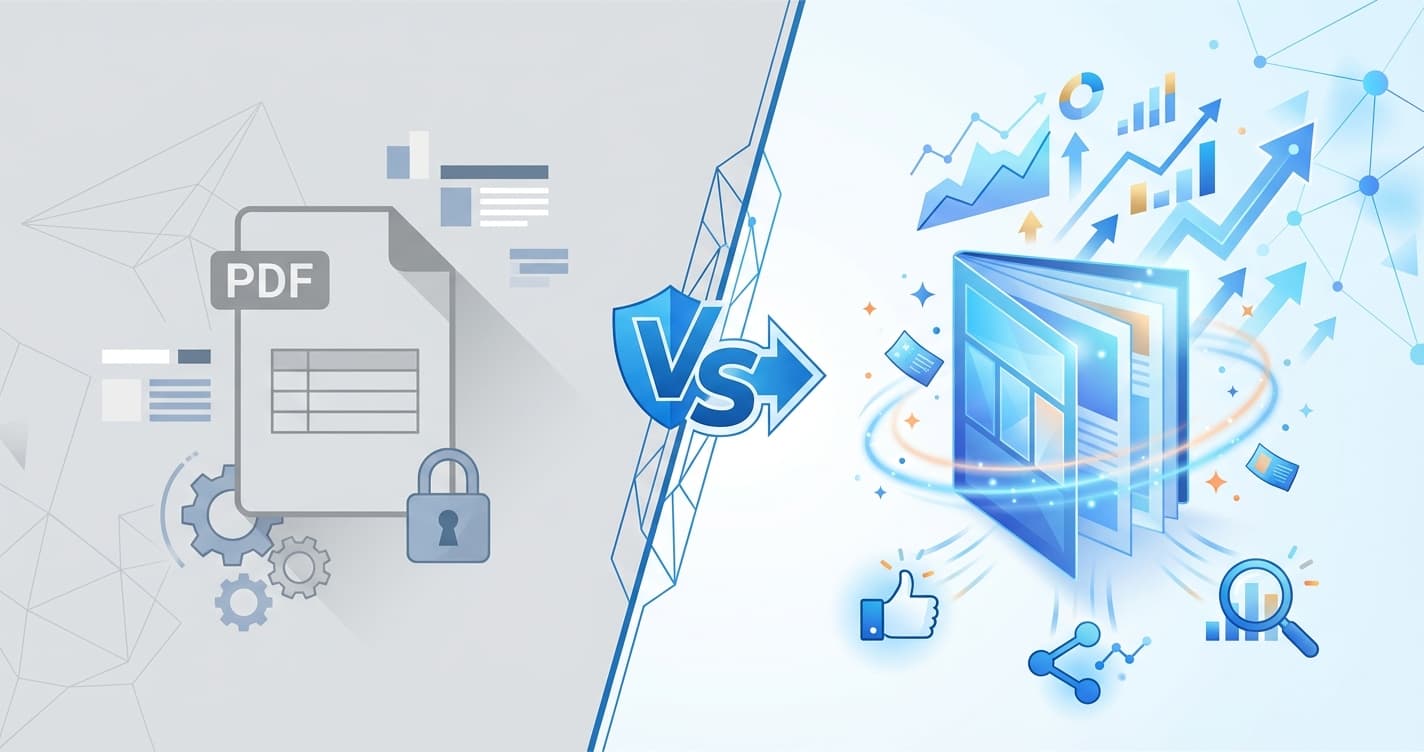
Flipbook vs PDF: Which Gets More Engagement?
A practical breakdown of when to use interactive flipbooks vs static PDFs — with data on engagement rates, reader behavior, and conversion impact.
The Default Is Changing
For twenty years, PDF has been the universal format for sharing documents. It's portable, it preserves formatting, and everyone can open one. But "everyone can open one" doesn't mean everyone does.
The average email attachment open rate is shockingly low. Studies consistently show that fewer than half of emailed PDF attachments are ever opened — and of those opened, the majority are abandoned within the first few pages.
Interactive flipbooks don't change the content. They change the experience. And the experience changes the numbers.
The Engagement Gap
Open Rates
A PDF attachment competes with every other attachment in the recipient's inbox. It requires a download step (even if it's just the browser loading a PDF viewer). It feels like work.
A flipbook link feels like a webpage. Click and you're in — no download, no separate application, no friction. This seemingly small UX difference has a measurable impact on whether people actually engage with the content.
Time on Content
PDFs are designed for scanning. Readers scroll, skim headings, and jump to the end. The linear scroll creates a "how much more is there?" anxiety that pushes readers to skim faster.
Flipbooks are designed for browsing. Page-turn animations create natural pauses. The page count is visible, giving readers a sense of progress. The format encourages spending time rather than racing through.
Completion Rate
Most PDF readers don't make it past the first few pages. The scroll-to-read format makes every page look the same — there's no sense of progress or discovery.
Flipbooks have a built-in completion mechanic: page turns. Each turn is a micro-commitment. The table of contents sidebar lets readers see the full structure and navigate to what interests them. Both features increase the percentage of readers who engage with the full document.
When to Use Each
Use a PDF When:
- The recipient needs to edit the content — contracts, forms, templates
- The document needs to be printed — legal filings, official records
- Offline access is required — field guides, reference materials for areas without connectivity
- The document is transactional — invoices, receipts, statements
PDFs excel when the document is a tool, not a presentation.
Use a Flipbook When:
- You need to track engagement — proposals, pitches, marketing materials
- Presentation quality matters — portfolios, brochures, reports
- The content is visual — photography books, catalogs, design work
- Access control is needed — confidential documents, gated content
- The content updates regularly — catalogs, menus, price lists
Flipbooks excel when the document is a communication — when you need the recipient to actually read it and you want to know if they did.
The Analytics Difference
This is the clearest dividing line. A PDF gives you nothing after you send it. A flipbook gives you:
| Metric | Flipbook | |
|---|---|---|
| Opened? | Unknown | Yes, with timestamp |
| Which pages read? | Unknown | Per-page dwell time |
| Time spent? | Unknown | Total and per-page |
| Forwarded? | Unknown | Multiple session detection |
| Return visits? | Unknown | Yes, with patterns |
| Downloaded? | Can't prevent | Controllable |
For any document where engagement data changes your next action (follow-up calls, content optimization, pipeline management), flipbooks provide intelligence that PDFs structurally cannot.
The Practical Middle Ground
You don't have to choose one format exclusively. Many teams use both:
- Produce the document as a PDF — your design workflow stays the same
- Upload to Bounder — convert it to a flipbook for sharing
- Share the flipbook link — for external distribution where tracking matters
- Keep the PDF — for internal use, printing, and archival
The PDF is the source file. The flipbook is the distribution format. Same content, different delivery — one with analytics, one without.
Try the Difference
The fastest way to see the engagement gap is to A/B test it yourself. Take your most important document — a proposal, a report, a catalog — and send it as a flipbook link to half your audience and as a PDF attachment to the other half. Compare open rates, engagement depth, and response rates.
Most teams see the difference within a single send.
Convert your first PDF to a flipbook — free, 60 seconds.